


Early Years
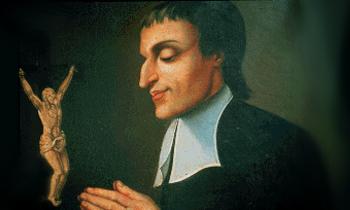
Louis Marie Grignion was born 31 January 1673 in the small town of Montfort-sur-Meu, just West of Rennes in Brittany, France. He was the eldest surviving child of the large family of Jean-Baptiste Grignion and his wife Jeanne Robert.
Louis Marie passed most of his infancy and early childhood in Iffendic, a few miles from Montfort, where his father had bought a farm known as "Le Bois Marquer". According to those who knew him at this early stage, he showed signs even then of a spiritual maturity uncommon in one of his age.
At the age of 12, he entered the Jesuit College of St Thomas Becket in Rennes, where, as well as doing well in his studies, he developed some of the enthusiasms which were to mark his later life. Listening to the stories of a local priest, the Abbé Julien Bellier, about his life as an itinerant missionary, he was fired with zeal to preach missions. And, under the guidance of some other priests he began to develop his strong devotion to the Blessed Virgin. At the same time, he began to experience the deprivations suffered by the very poor, and his love and care for them grew, not only in theory but in a practical way.
At some time during his college days, he became aware of a call to the priesthood, and at the end of his ordinary schooling, began his studies of philosophy and theology, still at St Thomas in Rennes. However, he was given the opportunity, through a benefactor, to go to Paris to study at the renowned Seminary of Saint-Sulpice. He set out for Paris towards the end of 1693.
Preparing for the Priesthood
Saint-Sulpice had been founded by Jean-Jacques Olier, one of the leading exponents of what came to be known as the "French School of Spirituality". With its emphasis on the mystery of the Incarnation, and on the place of Mary in God's Plan of Salvation, it was an ideal place for Louis Marie to develop the themes of his personal spirituality. Yet, other aspects of Sulpician spirituality do not seem to have attracted him so much: the tendency to place the clergy on a pedestal, to the point where there was a danger of their becoming "settled", not to say smug. His time at Saint-Sulpice, however, gave him the opportunity to study most of the available works on spirituality and, in particular, on Mary's place in the Christian life, especially when he was appointed librarian, nor did he waste the opportunity. He also had time to develop catechetical skills, especially among the deprived youth of Saint-Sulpice parish.
The time arrived for him to be ordained a priest in June 1700, and a few days later he said his first Mass at the altar of the Blessed Virgin in the church of Saint-Sulpice. He remained for a few more months in Paris, before setting out on his priestly ministry.
Early Priestly Ministry
The poor of Poitiers, however, had not rejected him, and they wrote to ask him to return to them. With the agreement of the Bishop, he returned to Poitiers to become the Director of the "Hôpital Général", and once again set about his reforms. He was helped in this by a young woman, Marie-Louise Trichet, who felt called to be a religious and to dedicate herself to the service of the poor. Louis Marie persuaded her to come to work with him at the "Hôpital Général", where later she was joined by another young woman, Catherine Brunet. These two, after many years of waiting, were to become the first members of the Daughters of Wisdom.
Louis Marie still continued to attract opposition by his reforms, and after several more months, he was persuaded by the Bishop and Marie Louis Trichet to leave the Hôpital for the second time. He began preaching missions in and around Poitiers, and probably felt that at last he was doing the work God had called him to do. Among the first missions was one in the very poor suburb of Montbernage, where he put into practice many of the features of his later missions: the call to a renewal of Baptismal Vows, the processions and lively liturgies which attracted the people who had often been neglected in the past. But his success seems to have aroused the jealousy of some who had the ear of the Bishop, and at the beginning of Lent 1706, he was forbidden to preach any more missions in the Diocese of Poitiers.
What was he to do now? He had become more and more convinced that he was called to preach missions, yet here was the Bishop of the Diocese forbidding him to do so. His thoughts turned to the Foreign Missions but he felt he needed some higher guidance. So he set off to make a pilgrimage to Rome, to ask the Holy Father, Pope Clement XI, what he should do. The Pope recognised his real vocation and, telling him that there was plenty of scope for its exercise in France, sent him back with the title of Apostolic Missionary. On his return to France, Louis Marie headed for Mont-Saint-Michel to make a retreat before seeking another field for his missionary endeavours in Brittany.
Missions in Brittany

After making his retreat at Mont-Saint-Michel, Louis Marie set off to find the missionary band headed by one of the greatest of Breton Missioners, Father Leuduger, and having caught up with them in Dinan, was accepted as a member of the team. Over the next few months he was involved in many missions in the dioceses of Saint-Malo and Saint-Brieuc, including one in his own birth-place, Montfort-sur-Meu, and others at Plumieux and La Chèze (where he rebuilt an ancient chapel, long since fallen into ruins, dedicated to Our Lady of Pity). Always he would choose for his own attention the poorest areas of the towns where the missions were held , and would often introduce some new initiatives for the relief of the poor, for example a soup-kitchen which was set up in Dinan.
He was perhaps not at his best, however, working with a team and, after several months, he left the mission band to spend a year at Saint-Lazare, just outside Montfort-sur-Meu, with two lay-brothers who had joined him. Here he occupied himself with teaching catechism to those who came to this ancient priory and schooling the two brothers in the art of community living. At the end of a year, he must have felt that other places offered him more opportunites for preaching missions and in 1708 he left to work in the Diocese of Nantes.
For two years, he preached many missions in and around Nantes, the vast majority of which proved extraordinarily successful in terms of the conversions wrought among the people. His reputation as a great missioner grew, but most of all he began to be known everywhere, by the ordinary people, as "the good Father from Montfort". He tried to perpetuate the spiritual results of his missions by setting up confraternities and associations which would encourage the people to be faithful to their renewal of Baptismal commitment, and by erecting physical reminders of the mission in the form of mission crosses. At Pontchateau, he attracted many thousands of people to help him in the erection of a more imposing reminder of the love of God, in the shape of a huge Calvary.
The Calvary of Pontchateau, however, was to be the cause of one of his greatest disappointments. On the very eve of its blessing, the Bishop, having heard that it was to be destroyed on the orders of the King himself, forbade its benediction. The whole sorry affair of the condemnation of the Calvary was the result of jealousy and petty revenge, but the Bishop evidently felt he had no choice but to curb the "excesses" of this extraordinary priest, and a few days later he forbade Louis Marie to do any more preaching in his diocese. This was just one, though perhaps the greatest, of the many instances where Louis Marie was called to share in the Cross of Christ. He did not let it get him down, but on the contrary reflected and meditated on it, and set down his reflections in one of his short writings, the Letter to the Friends of the Cross.
Although he was not banned from all work in the Diocese of Nantes, it was clear that if he wished to continue his preaching, he would have to go elsewhere. On the invitation of the Bishop of La Rochelle, he left Nantes in 1711 and entered the last period of his life, preaching missions in the Dioceses of La Rochelle and Luçon, in the Vendée region of France.
Last Years

The next five years, until his death in 1716, were extraordinarily busy ones for Louis Marie. He was constantly occupied in preaching missions, always travelling on foot between one and another. Yet he found time also to write - his True Devotion to Mary and The Secret of Mary, rules for the Company of Mary and the Daughters of Wisdom, and many Hymns which he used in his missions, often set to contemporary dance tunes. He made two major journeys, to Paris and to Rouen, to try to find recruits for his Company of Mary, of which he dreamt more and more as he drew towards the end of his life. And from time to time, he felt it necessary to withdraw to a place of quiet and isolation, in the Forest of Mervent or in his little "hermitage" at Saint-Eloi near La Rochelle.
His missions made a great impact, especially in the Vendée. It has been said that one of the reasons for the vigourous resistance of the people of this region to the anti-religious and anti-Catholic tendencies of the French Revolution 80 years or so later, was the strengthening of their faith by the preaching of St. Louis Marie. Yet he found it very difficult to persuade other priests to join him in his work as members of his Company of Mary. Finally, in the last year, two priests, Fr René Mulot and Fr Adrien Vatel, did join him, and he also gathered a certain number of lay-brothers to help him in his work.
The Bishop of La Rochelle, Mgr Stephen de Champflour, proved a great friend to him, although others continued to oppose him, and there was even an attempt made on his life. Together with the Bishop, he established free schools for the poor boys and girls of La Rochelle, and called Marie Louise Trichet and Catherine Brunet, who had waited patiently in Poitiers for 10 years, to come to help him. At last, they made their religious profession and the congregation of the Daughters of Wisdom was born. Soon there were others too who joined them.
Worn out by hard work and sickness, Louis Marie finally came in April 1716 to Saint-Laurent-sur-Sèvre to begin the mission which was to be his last. During it, he fell ill and died on 28 April. Thousands gathered for his burial in the parish church, and very quickly there were stories of miracles performed at his tomb. The two priests of the Company of Mary, Fathers Mulot and Vatel, retired to Saint-Pompain, with the handful of Brothers, where they waited for two years before taking up again the mission preaching so beloved of Louis Marie.
In 1888, Louis Marie was beatified, and in 1947, Pope Pius XII declared him a Saint. The congregations he left behind, the Company of Mary, the Daughters of Wisdom, and the Brothers of Saint Gabriel (whose congregation developed from the group of lay-brothers gathered round him), grew and spread, first in France, then throughout the world. They continue to witness to the charism of St Louis Marie, and to carry out his mission to establish the Kingdom of God, the Reign of Jesus through Mary.

No comments:
Post a Comment